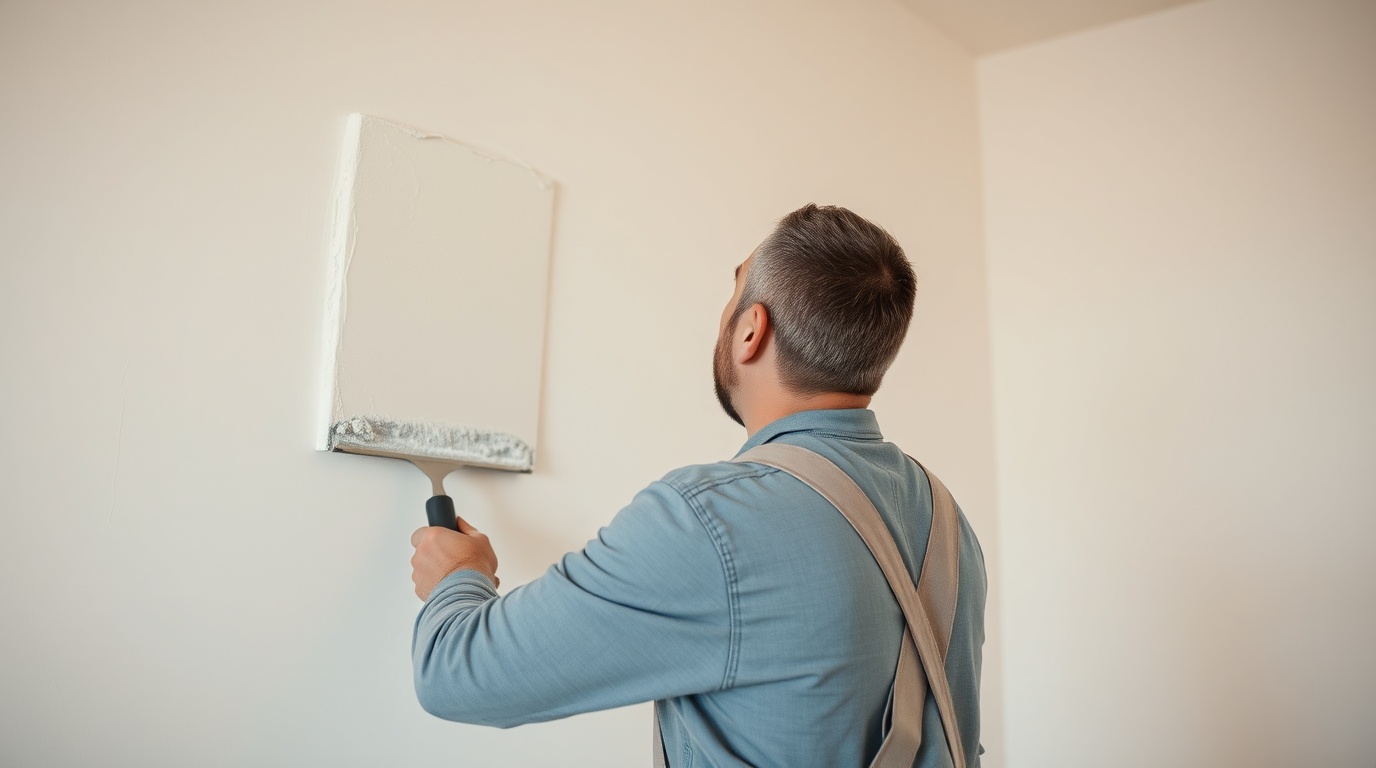
The short answer
Tape and joint finishes only the joints and screw heads — the board seams are filled, taped and feathered smooth, leaving most of the board face exposed and painted directly. A skim finish covers the whole board with a thin 2–3mm coat of plaster, giving a continuous smooth surface. Tape and joint is faster, drier and cheaper, common in new-build and commercial work, but the finish relies on the board's own face and can show joints under harsh light. A skim gives a more uniform, harder, traditional surface but costs more and takes a little longer to dry. Both are valid; the choice is finish quality versus speed and cost.
Once plasterboard is up, there are two standard ways to make it paint-ready. Here is how they compare.
Tape & joint vs skim
- Tape & jointJoints only, board face painted
- Skim finishWhole board plastered 2–3mm
- Speed / costTape & joint quicker, lower-cost
- FinishSkim more uniform & hard
- Common inT&J new-build; skim homes
What each method does
Tape and joint (also called jointing or 'taping') finishes only the parts of a plasterboard wall that are not already smooth: the joints between boards, the internal and external angles, and the screw or nail heads. The seams are filled with jointing compound, reinforced with paper or mesh tape, then built up and feathered out so the join disappears into the flat board face. The rest of the board — most of the wall — is the board's own paper face, which is then painted directly (often after a mist coat or primer).
A skim finish covers the entire board with a thin coat of finishing plaster, around 2–3mm, trowelled flat and polished. The whole surface becomes a continuous layer of plaster, so there is no distinction between board face and joint — it is uniformly plaster from edge to edge. This is the finish most UK homeowners picture when they think of 'a plastered wall'.
Cost, speed and finish compared
Tape and joint is generally faster and lower-cost: you are only treating the joints, not coating the whole wall, and it uses less material and brings less water into the building, so it dries quickly. It is the standard finish in much new-build housing and commercial fit-out, where speed and dry programmes matter. A skim coats everything, so it takes more time, more plaster and a longer dry, but it delivers a more uniform, harder surface.
| Factor | Tape and joint | Skim finish |
|---|---|---|
| Coverage | Joints, angles, screw heads | Whole board surface |
| Speed | Faster | Slower |
| Cost | Lower | Higher |
| Drying / water | Low | More |
| Surface uniformity | Board face + treated joints | Continuous plaster |
| Durability of surface | Good | Harder, more robust |
Indicative comparison for UK interiors. Finish quality also depends heavily on workmanship in either method.
Durability, decorating and where each suits
A skimmed surface is a continuous, harder plaster layer that resists minor knocks and gives a very even base for paint, which is part of why it is the traditional domestic choice. Tape and joint leaves the board's paper face as most of the surface; it decorates well and is perfectly durable, but the board face and the treated joints are technically different surfaces, so careful work and good paint are needed to keep the wall looking uniform, especially in strong light.
Decorating differs slightly too. New plaster from a skim needs a thinned 'mist coat' first to seal it before topcoats. A tape-and-joint wall needs the bare board face and the jointing compound primed so they absorb paint evenly — skipping that can leave the joints 'flashing' (showing as different sheen) through the paint. Done properly, both give a clean paint-ready wall; done carelessly, both can show their joints.
Which to choose
Choose tape and joint when speed, dry programme and cost are priorities and the lighting is reasonably kind — it is efficient, widely used in new-build and commercial work, and gives a good result with skilled jointing and proper priming. It also suits large areas where skimming everything would be slow and costly.
Choose a skim finish when you want the most uniform, hard, traditional surface, particularly in homes, feature rooms, or walls under strong or raking light where any joint line would show. It costs a little more and takes longer to dry, but it gives the continuous plaster look most people expect indoors. Both are legitimate ways to finish plasterboard; the decision comes down to how perfect and uniform you need the surface versus how much speed and cost saving you want.
It is worth understanding why new-build and commercial work leans so heavily on tape and joint, because the reasons can apply to your project too. On a large site, taping is faster, introduces far less water (so the building dries and follow-on trades start sooner), needs fewer wet-trade specialists, and uses tapered-edge boards specifically designed so the filled joint finishes flush. In that context the small risk of joints showing is managed by good jointing crews and controlled lighting, and the speed saving is large. In a home, the calculation often tips the other way: the areas are smaller so the time saved is modest, the lighting is less controlled (big windows, low lamps and side-lighting are unforgiving), and homeowners expect the continuous, hard plaster surface they associate with a 'proper' finish. That is why skimming remains the domestic norm even though taping dominates new-build — the right answer genuinely depends on the setting, not just the wall.
Board type and edge profile quietly shape this decision as well. Plasterboard sold for taping has tapered edges: the long edges are slightly recessed so that tape and jointing compound build the joint back up flush with the board face, leaving no bump. Board destined for skimming is often square-edged, because the whole face is going to be coated anyway and a tapered recess is unnecessary. Using the wrong board for the method makes life harder — taping square-edged board tends to leave a proud joint that is difficult to hide, while skimming is indifferent to the edge because it covers everything. There is also a repair-and-future angle: a small ding in a taped wall is patched with filler and touched-up paint, whereas damage to a skimmed wall is patched with plaster and may need re-skimming a section to blend. Neither is hard to live with, but it is another reason the two finishes suit different settings — high-churn commercial walls that get knocked and re-decorated often favour the quick-patch taped finish, while a home that wants a seamless, hard surface from the outset favours the skim. As with every choice here, the sensible move is to pick the board and the method together to match how the wall will be lit, used and maintained.
Frequently asked questions
Is tape and joint as good as skimming?
For a flat, paintable wall, yes — done well it is durable and widely used in new-build. The difference is that a skim coats the whole board for a continuous, harder surface, while tape and joint treats only the joints and leaves the board face exposed.
Will tape-and-joint joints show through paint?
They can if the jointing is not feathered smoothly or the board and compound are not primed evenly, causing 'flashing' or visible lines under strong light. Good jointing and proper priming prevent it; a full skim avoids the issue entirely.
Which is cheaper, taping or skimming?
Tape and joint is usually the lower-cost option because it treats only the joints rather than coating the whole wall, using less material and time and drying faster. A skim costs more but gives a continuous plaster finish.
Sources & further reading
Figures on this page are typical UK ranges drawn from published sources and depend on your specific room. They are guidance, not a quotation.